
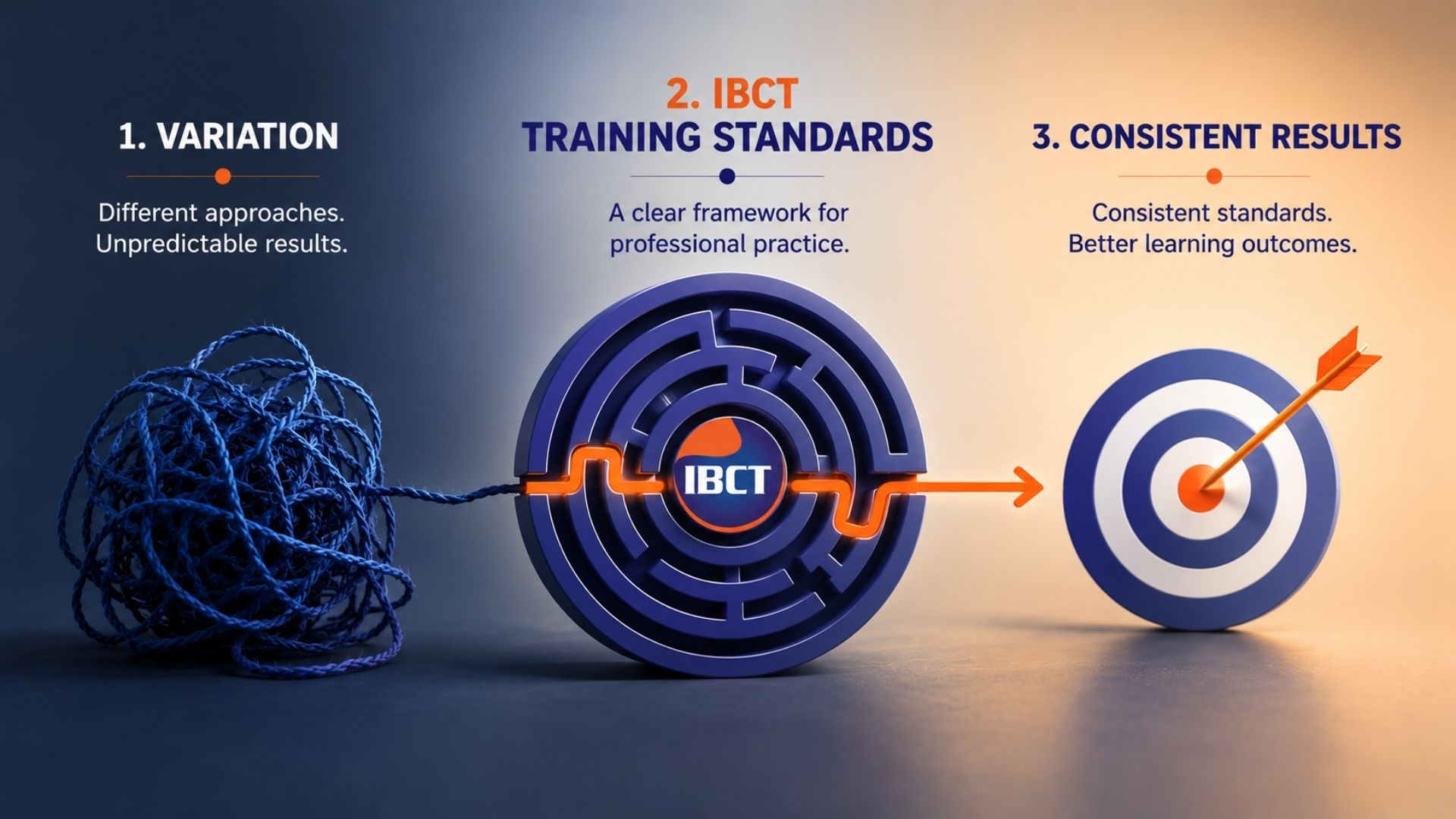
Imagine an organization delivering the same training program through ten different trainers: same topic, same objectives, same materials, same time.
Yet participants may walk away with ten completely different experiences.
One trainer may spend most of the time presenting. Another may focus heavily on activities. Another may improvise extensively. Another may be excellent at engaging participants but weak at assessment. Another may have tremendous subject-matter knowledge but limited understanding of adult learning.
Some produce excellent results. Others do not.
If the quality of training depends primarily on the individual trainer, can we really call it a professional system?
Is That Professional Consistency?
A great trainer can certainly deliver a great training session. But one successful session doesn't necessarily tell us whether the trainer can consistently:
- Identify learning needs
- Formulate meaningful objectives
- Design effective learning experiences
- Facilitate learning
- Assess achievement
- Evaluate effectiveness
- Improve future delivery
Professional training cannot be built around the assumption that every trainer will independently make the right decisions every time. That is precisely why professions develop standards.
The "Great Trainer" Myth
There is a tendency to define a great trainer by qualities such as:
- "They are charismatic."
- "They have 20 years of experience."
- "Participants love them."
- "They are excellent speakers."
- "They know the subject inside out."
All of these can be valuable. But none of them, individually, establishes professional competence. Consider the distinction:
| Subject-matter expertise | ≠ training expertise |
| Presentation skills | ≠ instructional competence |
| Participant satisfaction | ≠ learning |
| Experience | ≠ consistent application of best practice |
| Motivation | ≠ professional standard |
The Missing Ingredient: Standards
A professional standard provides a reference point for what good professional practice should look like. Rather than leaving every important decision entirely to individual preference, standards establish expectations around professional practice.
Without Standards
Individual preference → individual practice → variable quality
With Standards
Professional standards → consistent practice → more reliable quality
Standards don't guarantee that every training session will be perfect. Instead, they create a structured foundation for achieving and maintaining quality.
Standards Create a Common Professional Language
Imagine trainers, training providers, organizations, and certification bodies all using completely different definitions of effective training, good facilitation, appropriate assessment, learner engagement, training effectiveness, and trainer competence. There is no common benchmark.
Professional standards create a shared language:
- A trainer can ask: "What is expected of me as a professional trainer?"
- An organization can ask: "What should we expect from a certified trainer?"
- A certification body can ask: "What competencies should we assess?"
And the answer can be grounded in a defined professional standard, rather than personal opinion.
What Happens When Standards Are Applied Consistently?
Without standards
High intensity → decline → inconsistency → unpredictable results
With standards
Consistent professional practice → repeated quality → more reliable outcomes
The goal of standards is not to make every training session identical.
The goal is to make professional quality less dependent on chance.
IBCT Certification: Beyond a Certificate
This is where professional certification becomes meaningful. A certification should represent more than participation in a course or possession of a certificate. For IBCT, certification is positioned around demonstrated professional competence and commitment to recognized training standards.
Not just:
"I am IBCT certified."
But rather:
"I have been prepared and assessed against a defined professional standard, and I am expected to apply that standard in my professional practice."
Individuality Within a Standard
Standardization does not mean uniformity. IBCT standards should not require every trainer to speak the same way, use the same personality, facilitate in exactly the same manner, use identical activities, or eliminate creativity.
Your style can be different.
Your professional standard should not be.
A trainer can be:
The individual expression can vary. But the underlying professional principles remain.
Why This Matters to Trainees
Participants should not have to depend on luck to receive a quality training experience. They should be able to expect that professional trainers will:
- Understand how adults learn
- Establish meaningful training objectives
- Create purposeful learning experiences
- Facilitate rather than simply lecture
- Check whether learning has occurred
- Provide appropriate feedback
- Evaluate the effectiveness of the intervention
A learner should not have to ask, "Did I get a good trainer today?" Instead, they should be able to expect a professional standard of training.
Why This Matters to Organizations
Organizations invest significant resources in training. They need more than an engaging presenter — they need confidence that their training interventions are professionally designed, appropriately delivered, aligned with objectives, learner-centered, assessable, and capable of producing meaningful outcomes.
Certification standards provide organizations with an additional quality reference point when selecting or developing trainers. Organizations don't simply need trainers who can deliver a session — they need professionals who can contribute to effective learning and development.
From Certification to Professional Responsibility
Once someone becomes certified, the responsibility doesn't end. The professional question becomes:
"How consistently am I applying the standards I was certified against?"
This introduces professional accountability, continuous development, reflective practice, quality improvement, and commitment to learners. IBCT certification is a professional commitment, not simply an achievement.
The Ultimate Goal: Predictable Quality
We return to the original question: what happens when every trainer has their own definition of good training? The answer — quality becomes variable.
But when trainers operate within a shared professional framework:
Professional standards → consistent practice → greater quality consistency
→ more reliable learning experiences → stronger potential for positive outcomes
Standards do not make outcomes automatic. They create the conditions in which quality outcomes can be pursued consistently.
The IBCT Position
Great trainers can create great training. Professional standards help make great training more consistent, because professional training should not depend entirely on personality, motivation, or individual interpretation.
It should be grounded in standards that define professional practice, support consistency, and encourage continuous improvement.
Your style can be different.
Your professional standard should not be.
IBCT | One Standard. Every Trainer. Everywhere.




great blog!
Thank you!
Blog that provide deep insight in professional training!
We are glad that you liked it!